
Pomegranate Extract
Local Name - Pomegranate Extract
Botanical Name - Punica granatum
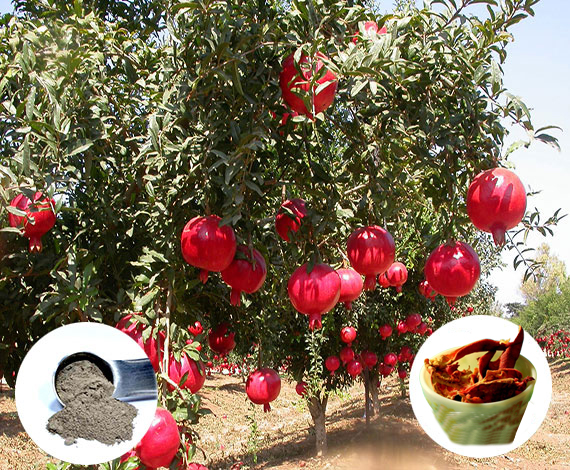
Plant Part used - Rind
Specification (Marker compound) -Ellagic acid by HPLC >8% , Tannins 10-20%
Description - Ayurveda differentiates between pomegranate varieties and employs them for different remedies.
Pomegranate has been used as a contraceptive and abortion by means of consuming the seed or rind, as well as by using the rind as a vaginal suppository. This practice is recorded in ancient Indian literature, in medieval sources, and in modern folk medicine.
Pomegranate seeds provide 12% of the Daily Value (DV) for vitamin C and 16% DV for vitamin K per 100 g serving, and contain polyphenols, such as ellagitannins and flavonoids
Pomegranate seeds are excellent sources of dietary fiber which is entirely contained in the edible seeds. People who choose to discard the seeds forfeit nutritional benefits.
Pomegranate seed oil contains punicic acid (65.3%), palmitic acid (4.8%), stearic acid (2.3%), oleic acid (6.3%) and linoleic acid (6.6%).
Juice, seeds and peel apparently contain steroid hormones, including estrone, although this is debated.
Therapeutic Applications:
Botanical Name - Punica granatum
Plant Part used - Rind
Specification (Marker compound) -Ellagic acid by HPLC >8% , Tannins 10-20%
Description - Ayurveda differentiates between pomegranate varieties and employs them for different remedies.
Pomegranate has been used as a contraceptive and abortion by means of consuming the seed or rind, as well as by using the rind as a vaginal suppository. This practice is recorded in ancient Indian literature, in medieval sources, and in modern folk medicine.
Pomegranate seeds provide 12% of the Daily Value (DV) for vitamin C and 16% DV for vitamin K per 100 g serving, and contain polyphenols, such as ellagitannins and flavonoids
Pomegranate seeds are excellent sources of dietary fiber which is entirely contained in the edible seeds. People who choose to discard the seeds forfeit nutritional benefits.
Pomegranate seed oil contains punicic acid (65.3%), palmitic acid (4.8%), stearic acid (2.3%), oleic acid (6.3%) and linoleic acid (6.6%).
Juice, seeds and peel apparently contain steroid hormones, including estrone, although this is debated.
Therapeutic Applications:
- Prostate Cancer
- Prostatic Hyperplasia
- Diabetes
- Lymphoma
- Rhinovirus Infection
- Common Cold
- Oxidative Stress in Diabetic Hemodialysis
- Atherosclerosis
- Coronary Artery Disease
- Infant Brain Injury
- Hemodialysis for Kidney Disease
- Male Infertility
- Aging
- Memory
- Pregnancy Complications
- Osteoporosis
- Erectile Dysfunction
Standardized Herbal Extracts - Nutracuetical
Contact Us
Srivari Natural Herbs (P) Ltd.
#999/07, 5th A Cross,
HRBR Layout, 1st Block,
Kalyanagar,
Bengaluru-560043
 +(91)-7829446065 / +(91)-9738519522
www.svnh.in Email : info@svnh.in
Disclaimer : These statements have not been evaluated by the Food and Drug Administration. These products are not intended to diagnose, treat, cure, or prevent any disease.


